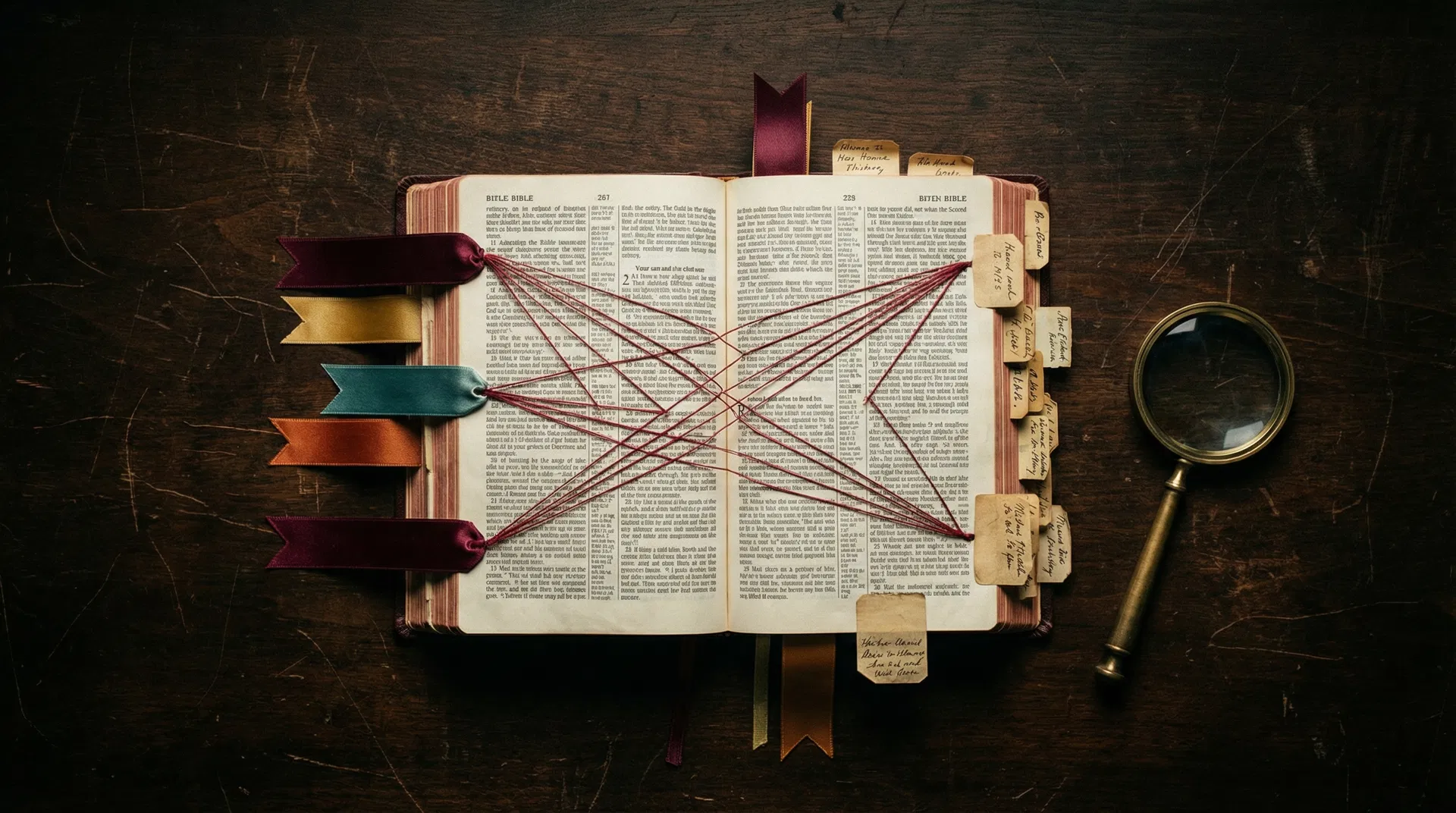
Understanding Cross-References in the Bible
Cross-references are the threads that weave the Bible together. Understanding how to use them transforms your reading from surface-level to deeply interconnected.
What Are Cross-References?
A cross-reference is a link between two or more Bible passages that share a common theme, phrase, prophecy, or theological concept. When you see a verse like Isaiah 7:14 — "Therefore the Lord Himself will give you a sign: Behold, the virgin shall conceive and bear a Son, and shall call His name Immanuel" (NKJV) — a cross-reference connects it to Matthew 1:23, where this prophecy is fulfilled in the birth of Jesus.
Cross-references are not additions to Scripture. They are tools that help readers see what the biblical authors themselves saw: that the Bible is one unified story told across 66 books.
Why Cross-References Matter
1. Scripture Interprets Scripture
The most important principle of biblical interpretation is that Scripture interprets Scripture. When a passage is unclear, related passages often provide the clarity you need.
As Lee Strobel discovered during his investigation of Christianity, the internal consistency of the Bible across centuries of authorship is one of its most compelling evidences. He writes that the way Old Testament prophecies find precise fulfillment in the New Testament convinced him that the Bible could not be merely a human product.
"Knowing this first, that no prophecy of Scripture is of any private interpretation, for prophecy never came by the will of man, but holy men of God spoke as they were moved by the Holy Spirit." — 2 Peter 1:20-21 (NKJV)
2. They Reveal the Unity of the Bible
The Bible was written over approximately 1,500 years by more than 40 authors from different backgrounds — kings, shepherds, fishermen, tax collectors, doctors, and prophets. Yet it tells one coherent story of God's redemption of humanity through Jesus Christ.
J. Warner Wallace, a cold-case detective, applied his investigative skills to the Gospels and found that the cross-referencing patterns between biblical authors are consistent with genuine eyewitness testimony rather than fabricated accounts. The authors corroborate each other in ways that would be nearly impossible to coordinate across centuries.
3. They Deepen Theological Understanding
Consider the concept of the "Lamb of God." In Genesis 22, Abraham tells Isaac, "God will provide for Himself the lamb" (Genesis 22:8, NKJV). In Exodus 12, the Passover lamb's blood protects Israel from judgment. In Isaiah 53:7, the Suffering Servant is "led as a lamb to the slaughter" (NKJV). In John 1:29, John the Baptist declares, "Behold! The Lamb of God who takes away the sin of the world!" (NKJV). And in Revelation 5:12, the heavenly hosts worship "the Lamb who was slain" (NKJV).
Without cross-references, you might read each of these passages in isolation. With them, you see a single, breathtaking narrative arc spanning the entire Bible.
Types of Cross-References
Direct Quotations
The New Testament directly quotes the Old Testament over 300 times. When Jesus says, "It is written, 'Man shall not live by bread alone, but by every word that proceeds from the mouth of God'" (Matthew 4:4, NKJV), He is quoting Deuteronomy 8:3.
Prophetic Fulfillment
Old Testament prophecies find their fulfillment in the New Testament. Micah 5:2 prophesied that the Messiah would be born in Bethlehem, and Matthew 2:1 records its fulfillment. Sean McDowell has documented hundreds of such fulfilled prophecies, arguing that the statistical probability of even a fraction of them being fulfilled by chance is astronomically low.
Thematic Parallels
Some cross-references connect passages that share a theme without directly quoting each other. For example, the creation account in Genesis 1 parallels the "new creation" language in 2 Corinthians 5:17: "Therefore, if anyone is in Christ, he is a new creation; old things have passed away; behold, all things have become new" (NKJV).
Typological Connections
A "type" is an Old Testament person, event, or institution that foreshadows something greater in the New Testament. Adam is a type of Christ (Romans 5:14). The bronze serpent lifted up in the wilderness (Numbers 21:9) is a type of Christ being lifted up on the cross (John 3:14-15).
How to Use Cross-References in Your Study
Step 1: Read the passage in context. Before following any cross-reference, make sure you understand the passage in its own context. Mike Winger consistently teaches that context is king in Bible interpretation. He warns against pulling verses out of their surrounding text and connecting them to unrelated passages.
Step 2: Follow the reference. Read the cross-referenced passage in its full context as well. Ask: How does this passage illuminate the one I started with?
Step 3: Look for the theological thread. What truth about God, humanity, sin, or salvation connects these passages?
Step 4: Note the progression. Biblical themes often develop from seed form in the Old Testament to full bloom in the New Testament. Track how a concept grows across Scripture.
"For whatever things were written before were written for our learning, that we through the patience and comfort of the Scriptures might have hope." — Romans 15:4 (NKJV)
Common Cross-Reference Chains
Here are some of the most important cross-reference chains in the Bible:
The Covenant Promise: Genesis 12:1-3 → Genesis 15:6 → Galatians 3:6-9 → Romans 4:1-5
The Suffering Servant: Isaiah 53 → Psalm 22 → Matthew 27 → 1 Peter 2:24
The New Covenant: Jeremiah 31:31-34 → Ezekiel 36:26-27 → Hebrews 8:8-12 → Luke 22:20
Justification by Faith: Habakkuk 2:4 → Romans 1:17 → Galatians 3:11 → Hebrews 10:38
Conclusion
Cross-references transform Bible reading from a collection of isolated stories into a unified revelation of God's character and plan. As William Lane Craig has argued, the internal coherence of the Bible across its diverse authorship is a powerful indicator of its divine origin. When you learn to follow the threads that connect Genesis to Revelation, you begin to see the Bible the way its Author intended.
Explore cross-references in the BibleCompass Reader → [blocked]