The Historical Reliability of the New Testament
Is the New Testament historically reliable? The manuscript evidence, eyewitness testimony, and archaeological discoveries provide a compelling case that it is.
The Question Every Honest Seeker Must Ask
Can we trust the New Testament? This is not merely an academic question. If the New Testament is historically reliable, then its claims about Jesus — His life, death, and resurrection — demand a response. If it is not reliable, then Christianity collapses.
As Lee Strobel discovered during his two-year investigation as an atheist journalist, the evidence for the New Testament's reliability is far stronger than most people realize. His investigation led him from skepticism to faith, not because of blind belief, but because of evidence.
"For we did not follow cunningly devised fables when we made known to you the power and coming of our Lord Jesus Christ, but were eyewitnesses of His majesty." — 2 Peter 1:16 (NKJV)
The Manuscript Evidence
Quantity of Manuscripts
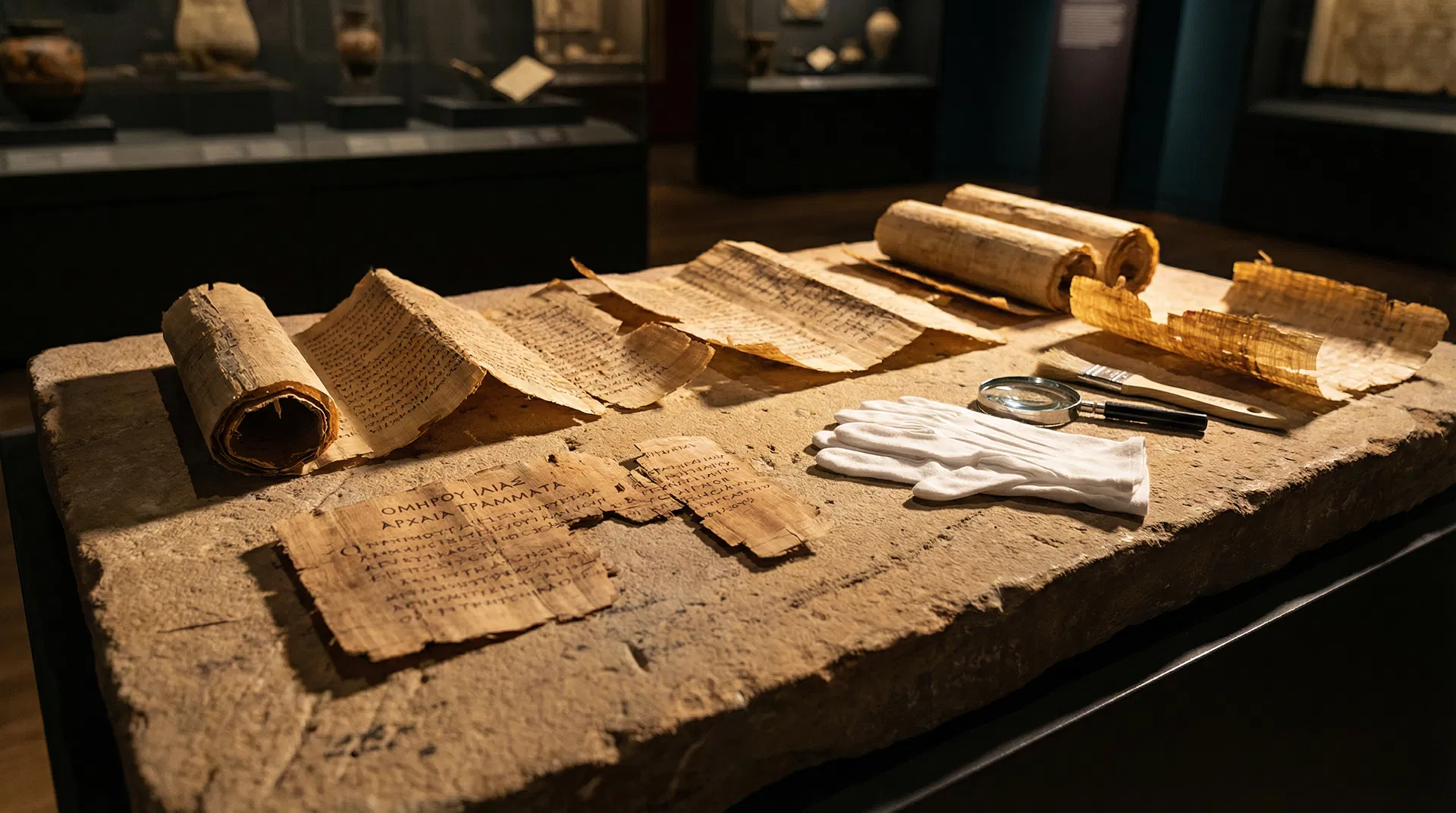
The New Testament has more manuscript evidence than any other ancient document — and it is not even close. There are over 5,800 Greek manuscripts, over 10,000 Latin manuscripts, and thousands more in other ancient languages, totaling more than 24,000 manuscript copies.
For comparison, the next best-attested ancient work is Homer's "Iliad" with approximately 1,800 manuscripts. Most classical works survive in fewer than 20 copies. If we reject the New Testament on manuscript grounds, we must reject virtually everything we think we know about the ancient world.
Time Gap
The earliest New Testament manuscript fragments date to within 25 to 50 years of the original writings. The John Rylands Papyrus (P52), a fragment of the Gospel of John, dates to approximately AD 125 — only about 30 years after John was written.
By contrast, the earliest manuscripts of most classical works date 700 to 1,400 years after the originals. The time gap for the New Testament is remarkably small.
Textual Accuracy
With so many manuscripts, scholars can compare them to identify and correct any copying errors. As Sean McDowell has documented, the New Testament text is approximately 99.5% textually pure. The remaining 0.5% consists of minor spelling variations and word-order differences that affect no doctrine or historical claim.
Eyewitness Testimony
The Gospels as Eyewitness Accounts
The Gospels were written by eyewitnesses or close associates of eyewitnesses. Matthew and John were among Jesus' twelve disciples. Mark is widely understood to have recorded the testimony of Peter. Luke explicitly states that he investigated everything carefully from the beginning, interviewing eyewitnesses:
"Inasmuch as many have taken in hand to set in order a narrative of those things which have been fulfilled among us, just as those who from the beginning were eyewitnesses and ministers of the word delivered them to us, it seemed good to me also, having had perfect understanding of all things from the very first, to write to you an orderly account." — Luke 1:1-3 (NKJV)
The Cold-Case Detective's Verdict
J. Warner Wallace, a former cold-case homicide detective and atheist, applied his professional investigative techniques to the Gospels. He evaluated them using the same criteria he used to assess witnesses in criminal cases: Were they present? Were they corroborated? Were they accurate? Were they biased?
Wallace concluded that the Gospel writers pass every test of reliable eyewitness testimony. Their accounts contain the kinds of undesigned coincidences, incidental details, and embarrassing admissions that characterize genuine testimony rather than fabricated stories.
Early Creedal Statements
Paul records a creed in 1 Corinthians 15:3-7 that scholars date to within two to five years of the crucifixion:
"For I delivered to you first of all that which I also received: that Christ died for our sins according to the Scriptures, and that He was buried, and that He rose again the third day according to the Scriptures, and that He was seen by Cephas, then by the twelve." — 1 Corinthians 15:3-5 (NKJV)
Gary Habermas has identified this creed as the earliest Christian statement of faith, demonstrating that belief in Jesus' death and resurrection was not a later legend but an immediate conviction of the earliest Christians. Using his "minimal facts" approach — relying only on data accepted by virtually all scholars, including skeptics — Habermas argues that the resurrection is the best explanation for the historical evidence.
Archaeological Confirmation
Confirmed People and Places
Archaeology has repeatedly confirmed the historical details recorded in the New Testament. The pool of Bethesda (John 5:2), once dismissed as fictional, was discovered by archaeologists in the 19th century. The inscription of Pontius Pilate was found at Caesarea Maritima in 1961. The Gallio Inscription confirmed the date of Paul's time in Corinth (Acts 18:12-17).
No Contradictions Found
As Lee Strobel has noted, archaeology has not produced a single finding that contradicts the New Testament. On the contrary, discovery after discovery has confirmed the accuracy of Luke's geographical, political, and cultural details. Sir William Ramsay, a 19th-century archaeologist who set out to disprove Acts, concluded that Luke was a historian of the first rank.
The Criterion of Embarrassment
One powerful test of historical reliability is the "criterion of embarrassment." Genuine historical accounts include details that are embarrassing or inconvenient for the authors. Fabricated accounts do not.
The Gospels include numerous embarrassing details: Peter, the leader of the apostles, denies Jesus three times. The disciples repeatedly fail to understand Jesus' teachings. Women — whose testimony was not considered legally valid in first-century Jewish culture — are the first witnesses of the resurrection.
As Mike Winger has pointed out, if the Gospel writers were inventing a story to promote their movement, they would not have included details that made their leaders look foolish and their key witnesses legally unreliable. The inclusion of these details is a hallmark of honest reporting.
The Willingness to Die
The apostles claimed to be eyewitnesses of the risen Jesus, and nearly all of them died for that claim. People die for beliefs they hold to be true, but people do not die for claims they know to be false.
Sean McDowell's doctoral research on the fate of the apostles concluded that while we cannot verify the martyrdom of every apostle with equal certainty, the evidence strongly supports that the earliest Christians were willing to suffer and die rather than recant their testimony. This willingness is powerful evidence that they genuinely believed they had seen the risen Christ.
"And they overcame him by the blood of the Lamb and by the word of their testimony, and they did not love their lives to the death." — Revelation 12:11 (NKJV)
Conclusion
The New Testament is the best-attested document from the ancient world. Its manuscript evidence is unparalleled. Its authors were eyewitnesses or associates of eyewitnesses. Its historical details have been repeatedly confirmed by archaeology. And its earliest witnesses were willing to die for their testimony.
As Frank Turek has argued, it takes more faith to reject the New Testament than to accept it. The evidence does not require a leap of faith — it rewards an honest investigation.
Explore apologetics resources on BibleCompass → [blocked]